




.webp?width=164&height=99&name=GKG_Logo_Stacked_4C_NoTag%20(1).webp)






Letter from the CEO
Jim Carroll
CEO, Professional Services Council
 On behalf of PSC and our member companies, it is my honor to introduce the AI in National Security Compendium.
This publication highlights the powerful capabilities AI can deliver across the federal enterprise and the essential partnership between government and the private sector to best utilize these cutting-edge technologies and support national security.
AI is already mission critical. These real stories of PSC member companies supporting federal agencies and delivering AI solutions highlight the vital role contractors play in delivering innovation, speed and scalability to the government. This partnership is essential to accelerate AI adoption, manage risk, and maintain U.S. technological advantage.
From providing data solutions that accelerate decision-making, to mission staffing and battle management, federal contractors are dedicated to being a trusted partner to the federal government.

 Artificial intelligence is no longer an “emerging” technology. It is actively reshaping how government agencies operate to fulfill their missions, deliver services to citizens, and make decisions. While opinions differ on AI regulation, there is broad agreement that the Federal government must use AI safely and security and be an accountable user of this technology. The document describes priority needs for the government AI infrastructure (human, institutional, and technical) to improve government services, protect national security, and, importantly, enhance and maintain public trust. In many cases, agencies are struggling to find their own ways through the challenges of AI and are each re-inventing solutions on their own. We propose greater, more integrated investment and collaboration across the whole of government.
Three Priorities for Congressional Action to Support Agencies
1. Build the Foundation
Before agencies can deploy AI at scale, they need the basics in place. That means clear governance, clean and interoperable data, a workforce prepared for new ways of working, and cybersecurity postures that account for a fundamentally different threat landscape. Delays in this area don't just slow progress, they create risk.

 Using AI to Strengthen Military Medical Readiness
Modern national security operations generate enormous volumes of operational, logistical, surveillance, and medical data. Yet despite this abundance of information, leaders struggle to quickly answer straightforward readiness questions. In large-scale military operations, decision windows compress while uncertainty increases. Commanders must make rapid, high-consequence decisions that integrate information from multiple domains and organizations. Transforming fragmented data into operational insight becomes a readiness imperative, and AI is emerging as a critical enabler of this transformation.
Fragmented Data = Slower Decisions
Across the defense enterprise, critical data exists in dozens of systems developed over decades to support distinct mission sets, including logistics platforms, medical systems, transportation models, and personnel datasets. Each system captures important information, but disparities in structure, classification, and terminology make integration difficult.
Modern mission environments demand a different approach in which diverse datasets can be unified, analyzed, and translated into operational decisions at mission speed.
"In large-scale operations, decision windows compress while uncertainty increases, requiring analytic systems that deliver insight at operational speed.”
Data to Decisions
DLH has been working to address this challenge using a framework that integrates AI and machine learning with modern data architecture.
Our approach is grounded in semantic data unification, aligning data from multiple systems so that complex concepts can be understood across platforms and over time. Rather than forcing legacy data systems to adopt a single standard, the semantic ontology defines relationships between data elements while preserving the meaning and provenance of the original data sources.
Once unified, data can be analyzed using advanced analytics, machine learning, and simulation tools to generate decision-ready insights. The goal is to enable leaders to ask operational questions across the data enterprise and receive defensible answers at decision speed.
Case Study: Modeling the Military Medical System
In modern conflicts, casualty care extends far beyond the battlefield. Patients move through a complex system that includes forward treatment facilities, evacuation hubs, transportation networks, and definitive care hospitals in the US and partner health systems.
While existing planning tools can model casualty movement through early stages of care, there is limited capability to simulate the Role 4 phase of care, where casualties enter the broader U.S. medical system for definitive treatment.
This gap makes it difficult to answer critical readiness questions:
-
- How many casualties can the national medical system absorb during a major contingency?
- Where will bed capacity or specialty resource shortages occur?
- How will delays in transportation or evacuation affect the system load?
This challenge can be addressed using an AI-enabled data platform that integrates operational scenarios, transportation networks, and hospital resource data into a unified analytic environment.
.webp?width=182&height=109&name=GKG_Logo_Stacked_4C_NoTag%20(1).webp)
.jpg?width=524&height=276&name=Mission%20Intel_SM%20(1).jpg)
The Department of War (DoW) and the Intelligence Community (IC) are operating in an environment where mission timelines are accelerating faster than the systems designed to support them. The talent required to meet emerging threats already exists within the enterprise, but significant friction remains in identifying, validating, and assembling the right personnel quickly while maintaining strict security, access controls, and defensible decision-making. Traditional staffing cycles rely heavily on manual coordination and fragmented data, forcing mission owners to repeatedly rebuild an understanding of who is skilled, available, and eligible to support urgent operational demands.
The challenge is not a shortage of expertise. It is the administrative burden that consumes expert time: searching spreadsheets, chasing email threads, cross-checking training and certifications, confirming availability, validating access constraints, and relying on tribal knowledge to infer skill depth. Under pressure, these delays slow missions, introduce inconsistency, and create decisions that are difficult to justify after the fact. What the DoW and IC require is faster, clearer visibility into personnel capabilities so teams can be formed at mission speed without shifting administrative overhead onto already overtasked experts.
The Mission Agile Talent and Competency Hub (MATCH) was designed to break this cycle. Built on proven private-sector AI patterns and adapted for national security environments, MATCH applies structured skills mapping, intelligent matching, and mission-aware workflow automation to accelerate the team formation process. MATCH does not replace human judgment; it strengthens it by reducing time spent on data gathering and administrative triage. The system automates discovery, validates constraints earlier in the process, and generates evidence-backed recommendations that are faster to approve, easier to adjust, and fully defensible. Each recommendation is linked to skill evidence, each constraint is verified upfront to minimize rework, and every decision is captured in an audit-ready trail that supports accountability and after-action analysis.
At its foundation, GKG MATCH delivers a clear value proposition: map personnel to validated skills, align those skills to mission needs, and rapidly generate secure, evidence-supported shortlists and rosters. MATCH integrates authorized personnel data, training records, certifications, prior assignments, availability indicators, and clearance or access restrictions into a unified workflow. This creates speed without sacrificing control: mission owners see relevant evidence, constraints are applied consistently, and decision authority remains human-owned and defensible.
Technically, MATCH fuses skills intelligence with constraint-aware matching to accelerate staffing while preserving mission owner authority. It normalizes data from authoritative sources and uses modern search and ranking methods to align mission requirements with validated skills and experience. The matching engine evaluates candidates against real world constraints, including availability windows, access caveats, assignment restrictions, and conflicts, then produces ranked shortlists with transparent rationale and evidence links. The output is not just a list of names; it is a fully defensible staffing package explaining why each individual is recommended, what evidence supports the match, and which constraints were considered.
-
- AI-powered skills mapping
- FedRAMP High-aligned cloud infrastructure
- Role-based access and mission-level controls
- Teams assembled at mission speed
- Evidence-backed candidate shortlists
MATCH is deployed on a government-grade platform purpose-built for security and auditability. Salesforce Government Cloud environments designed for U.S. government use align to FedRAMP High and DoD Impact Levels depending on mission needs. This is essential because team formation involves sensitive data, strict access controls, and governance requirements that must withstand rigorous scrutiny. As a cloud platform, it supports secure access across approved devices and locations, and benefits from Salesforce’s continuous upgrade cycle, modernizing capabilities without requiring new, large-scale upgrade efforts.
A practical example highlights MATCH in action: An NGA mission owner receives urgent direction to assemble a short-notice GEOINT support cell for a fast-moving contingency. Historically, this would trigger a scramble across spreadsheets, outdated rosters, inbox searches, and informal networks followed by repeated availability checks, access confirmations, and manual vetting. This approach consumes valuable time, increases operational risk, and often results in limited documentation explaining staffing decisions.
"By integrating authorized data, applying access and availability constraints, and generating audit-ready recommendations, MATCH delivers speed without sacrificing control or accountability.”
With GKG MATCH, the workflow changes fundamentally. The mission owner defines required roles and competencies; MATCH maps those requirements to personnel with documented skill evidence—including training, certifications, prior assignments, and mission performance data where authorized. The system applies operational constraints early, filtering by availability and access considerations to prevent late-stage surprises. Within minutes, MATCH generates ranked shortlists with linked evidence and clear rationale. Decision authority stays with the mission owner, but with richer information and dramatically reduced administrative burden. Every decision including overrides or supervisor adjustments—is recorded in an audit-ready format supporting defensibility, accountability, and after-action review.
This approach aligns with enterprise-wide priorities emphasizing agility, speed, and the adoption of proven technology. Senior intelligence leaders consistently underscore the need to equip professionals to focus on the human-centric work that matters most: judgment, analysis, tradecraft, and decision-making. Fragmented manual review slows operations; responsible automation accelerates them. MATCH embodies this philosophy by shifting time away from administrative processing toward planning, execution, and mission outcomes.
MATCH is also structured to leverage existing DoW investments. The DoW’s Salesforce Enterprise License Agreement provides a direct path to extending current platform capabilities rather than introducing separate point solutions with new tools, new security overhead, and new user adoption. This results in faster time-to-field, fewer new systems to learn, and a streamlined approach to governance, access control, and data management.
Beyond technology, GKG MATCH reflects a foundational organizational commitment. As GKG CEO G. McCracken states: “We ensure you have the right people, with the right skills, at the right time, to accomplish your mission.” MATCH operationalizes this commitment by transforming team formation from a manual, reactive process into a proactive, evidence-driven workflow. Skills become traceable, availability is validated early, access constraints are consistently respected, and staffing decisions become fully defensible.
Mission success depends on having the right team in place at the right moment. GKG MATCH removes the obstacles that slows team formation and replaces it with clarity, speed, and trust. By integrating evidence backed skills mapping, constraint-aware matching, and human-in-the-loop decision authority, MATCH equips the DoW and IC to meet urgent operational demands without compromising control, compliance, or accountability. The result is mission-ready teams assembled faster and leaders supported with the information they need to act at the pace of modern national security.


National security challenges are evolving at unprecedented speed. Adversaries are expanding and accelerating their technological investments. Aerial threats are becoming more sophisticated and harder to detect. Cyber operations are more aggressive, more persistent and more deeply intertwined with every mission. And across all domains—air, land, sea, space and cyber—data continues to grow in volume, speed and complexity.
Meeting these challenges requires more than technology modernization. It requires a shift in how the national security community evaluates, integrates and operationalizes emerging capabilities. AI, cyber resilience and innovation-driven engineering are no longer optional, but are foundational.
At GDIT, we see this evolution in every mission we support. And we see how combining disciplined engineering with a culture of innovation enables agencies to maintain decision advantage in an environment where each second matters and trust is essential.

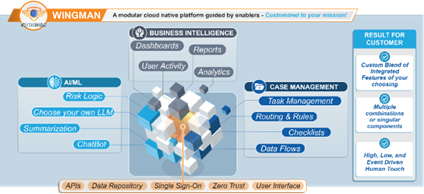
Wingman is iWorks’ modular, cloud-native platform designed to transform complex mission data into actionable intelligence. By combining artificial intelligence, dynamic case management, and embedded analytics, Wingman enables organizations to accelerate decision-making, automate operational workflows, and improve visibility across mission environments. Built to enhance - not replace - existing systems, the platform integrates securely across enterprise technology landscapes to unify data, workflows, and insights into a cohesive operational workspace.
Organizations today face increasing operational challenges driven by disconnected systems, manual research processes, growing data complexity, and inconsistent risk identification. Workforce knowledge gaps and limited performance visibility further slow mission execution. Wingman addresses these challenges by enabling intelligence-led operations through configurable AI engagement, workflow automation, and real-time analytics that support faster and more informed mission outcomes.
Platform Capabilities
Wingman delivers integrated mission capabilities that enable organizations to convert enterprise data into operational insight while improving process efficiency and collaboration. AI-driven knowledge discovery allows users to interact with mission data through natural language search, automated summarization, pattern identification, trend detection, and configurable risk logic that helps surface priority issues in real time. Dynamic case management capabilities support adaptive workflows through task routing, checklists, rule-based automation, and configurable data flows that evolve with mission needs. Embedded business intelligence tools provide real-time dashboards, analytics, reporting, and user activity monitoring directly within operational workflows, improving transparency and enabling data-driven performance management.
Wingman operates within a secure, configurable low-code/no-code workspace built on zero-trust architecture and robust API interoperability. Vendor-agnostic and scalable by design, the platform enables organizations to reduce technology costs, accelerate deployment timelines, and align technology, data, and analytics to drive operational excellence across mission environments. Its modular cloud-native foundation supports deployment across on-premise, hybrid, or cloud environments, allowing teams to introduce targeted capabilities or scale enterprise-wide adoption without disruptive system overhauls.
Why Wingman
Wingman enables organizations to modernize operations without replacing existing systems, supporting phased adoption aligned with mission priorities and resource constraints. By integrating AI-enabled analytics, workflow automation, and performance visibility into a single platform, Wingman helps teams reduce manual effort, improve collaboration, and accelerate time to operational value. Leadership gains real-time insight into operational performance through embedded analytics, while configurable AI autonomy ensures human decision-makers remain central to mission execution.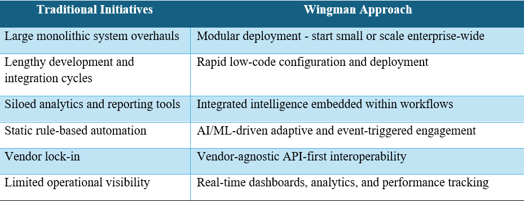

.jpeg?width=403&height=269&name=Alpha_Mosaic%20(1).jpeg)
Three Points to Remember
1. Military operators need to make important decisions rapidly during combat but can struggle to process information fast enough.
2. AlphaMosaic, developed by Leidos, enables AI agents to provide operators with decision support in combat scenarios involving multiple aircraft, weapons systems and targets.
3. AlphaMosaic has successfully supported battle exercises, and there’s potential that the AI technology can be scaled to address decision-making for warfighters in a variety of roles.
An F-15EX fighter jet like this one was used in a recent exercise to demonstrate AI-powered battle management with Leidos' AlphaMosaic software. Credit: DVIDS (The appearance of U.S. Department of Defense visual information does not imply or constitute DoD endorsement.)
Flying high at 30,000 feet, a weapon systems officer (WSO) in the back seat of an F-15EX fighter jet faces a cascade of critical decisions during an air battle. The enemy has superior numbers, and multiple targets demand attention. Fuel reserves need constant monitoring. Coordination with a dozen other aircraft requires split-second timing. But instead of juggling paper charts and mental calculations, the WSO taps a tablet displaying real-time, AI-generated options. Risk levels for each course of action appear in clear visual formats. Weapon-and-target pairings optimize themselves based on mission priorities. What once took 20 to 30 minutes now happens in seconds in a situation where decision advantage and time are critical.
This scene played out in an early 2025 exercise at Eglin Air Force Base and represented years of artificial intelligence development experience that was compressed into a 90-day sprint from concept to cockpit. The technology enabling this transformation into the rapidly deployable solution — AlphaMosaic, developed by Leidos — emerged from the Defense Advanced Research Projects Agency's (DARPA) Air Combat Evolution (ACE) program as a flexible framework enabling AI agents to provide decision support to warfighters.
“We’ve gone from sim to reality and burned down significant risks towards fielding,” says Tim Keeter, collaborative autonomy lead and master solution architect at Leidos. “Understanding and collaborating with these agents mirrors the way humans have always done this with each other.”
AlphaMosaic exemplifies how Leidos leverages innovative autonomous solutions and mission software to protect our national security. With further development, there’s potential that the AI technology in AlphaMosaic can be scaled to address decision-making for warfighters in a variety of roles.
The Complexity Challenge
Modern warfare presents military operators with decision-making burdens that can quickly become overwhelming. As conflicts grow more complex, with multiple aircraft, weapons systems and rapidly changing scenarios, human operators will undoubtedly struggle to process information fast enough to maintain tactical advantage. The U.S. military knows this, and it is prioritizing efforts to find solutions. And Leidos understands the urgency in solving this challenge, as it’s critical for the success of our nation’s warfighters.
“The battle hits you all at once and you’ve got to make 30 to 40 minutes' worth of decisions in 30 seconds if you want to maintain decision superiority,” explains Kevin Albarado, lead autonomy architect and program manager for AlphaMosaic. “You can’t preempt any of it. There are just too many decision pathways there.”
Consider a related challenge: aerial refueling. It's another process that demands intensive human coordination. Mission planners must determine who needs fuel, when they need it and how to maintain combat readiness throughout the operation. One disabled tanker can cascade into mission failure without rapid replanning.
“It’s a pretty high cognitive burden, requiring teams of people, to come up with one of these fuel schedules quickly,” Albarado says. That’s where AlphaMosaic-developed AI agents come in. “But it’s a pretty low burden to look at a schedule optimized and proposed by our software and go, ‘That one works,’” Albarado explains. “So we’re just providing the one that works, and we’re doing it while also helping with a lot of other decisions that battle managers have to make.”
The Different Kind of AI
In contrast to one monolithic AI system, AlphaMosaic employs a network of specialized AI agents that mirror how military teams already operate. Each agent handles specific decisions — fuel scheduling, weapon assignment, flight positioning — while communicating within a larger ecosystem.
“We’re essentially building a virtual, augmenting workforce,” says Will Mahoney, vice president and CTO of airborne systems at Leidos. “And they work together under the supervision of the human operators to achieve these things.”
This disaggregated approach offers critical advantages. Individual agents can be updated without overhauling the entire system. Human operators can intervene at any level, from tactical details to strategic planning. Most importantly, the system presents complexity to adversaries while simplifying decisions for friendly forces.
Although trained on sophisticated server arrays, the framework deploys as lightweight microservices rather than requiring large computing infrastructures to operate. That means AlphaMosaic agents run on standard tablets and regular CPUs — even years-old legacy hardware.
"We're essentially building a virtual, augmenting workforce. And they work together under the supervision of the human operators. - Will Mahoney, VP, Airborne Systems CTO"
From Laboratory to Cockpit
The Blue Horizons Fellowship program at Maxwell Air Force Base provided AlphaMosaic’s most dramatic real-world validation. A team of three officers challenged the Leidos team to solve the persistent problem of matching weapons to targets across complex battlespaces.
Working with the AlphaMosaic framework, the team created Jarvis (named after the Marvel Comics AI assistant) in just 90 days. The application transformed battle planning from a 20- to 30-minute manual exercise into a 15-second digital process.
During testing at Emerald Flag exercises, WSOs using tablet-based Jarvis were able to evaluate three risk-based options simultaneously: prioritizing aircraft survivability, maximizing speed to target and accepting higher risk for maximum lethality.
“It gives them a menu of options to choose from versus the weapon systems officer having to go through that calculation and think through it from scratch,” Mahoney explains. One WSO even requested additional targets, finding that the AI assistance freed up cognitive capacity for more complex tactical thinking.
It’s one thing to present these solutions so quickly but another for the operators to trust the solutions. Repeatedly, highly experienced WSOs admitted that had they had more time to develop the solutions, they would have made the same decisions recommended to them by Jarvis.
The total investment was a fraction of traditional defense development costs (under $1 million), made possible thanks to integration with existing data and hardware. “We don’t deliver things to the warfighter that they don’t already know how to use; that wouldn’t make sense to them,” Keeter says. “We work with the data they already have. We work with the systems they already have. And we are elastic enough to incorporate new technology as the customer adds it.”
Expanding the Mission Envelope
AlphaMosaic’s next deployments will likely focus on aerial refueling through an ongoing research and development campaign. The AI agents have demonstrated the ability to quickly recalculate fuel schedules in response to equipment failures or changing combat situations, maintaining fuel schedules that keep all aircraft mission-capable.
One surprising capability emerged during the DARPA ACE program.
AlphaMosaic agents began calling aircraft for refueling after using only 20% of an aircraft’s fuel — seemingly premature until analysis revealed the AI was positioning aircraft for critical engagements many moves ahead, like a chess master preparing for an endgame.
The framework’s flexibility has the potential to enable applications across the entire spectrum of combat. At the pilot level, agents could assist with immediate tactical decisions. Air operations centers could use AlphaMosaic for broader battle management. Mission planners could evaluate different scenarios before aircraft launch. Operational analysis teams could model how new platforms and weapons systems might perform in future conflicts.
“We’re pressing hard on this, and it’s important to us,” Keeter says. “It’s not just important to us as a company. It’s important to us as patriots.”


Overview of our Practice
AI is revolutionizing mission-critical operations and empowering the government’s operations and decision-making. MANTECH’s Data and AI Practice is at the forefront of delivering impactful AI solutions that drive mission success. Our technology-agnostic approach leverages a variety of partnerships to provide innovative, state-of-the-art solutions that ensure clients remain at the cutting edge
Key Differentiators
We prioritize speed-to-delivery and tailor our solutions, incorporating AI Development and Architecture design, to meet each client’s unique needs. We simplify AI adoption, enabling clients to quickly harness AI capabilities and achieve rapid results. Our comprehensive approach includes designing Data and AI solutions that meet clients where they are, building and integrating solutions for deployment, and sustaining those solutions while integrating them fully with broader operations for maximum impact.
Supporting National Government Imperatives
Digital Optimization: AI automates tasks, streamlines operations, and optimizes resource allocation, enabling agencies to reallocate human hours from low-value tasks to more strategic endeavors.
Intelligence Exploitation: AI-driven solutions play a critical role in timely processing and analyzing vast amounts of data - aiding analysts and operators to proactively identify and mitigate threats.
Cybersecurity: AI is revolutionizing cybersecurity by enabling real-time threat detection, analysis, and response, enhancing capabilities to meet Zero Trust requirements and mitigating insider threats.
.jpg?width=304&height=324&name=Operationalizing%20AI%20(1).jpg)
Force and Asset Readiness: AI is ensuring mission-critical asset readiness and securing supply chains through designing and accurately predicting potential equipment failures or maintenance requirements and optimizing business efficiency.
Situational Awareness and Decision Acceleration: AI is providing executive situational awareness and decision acceleration through highly adaptable analytics platforms that reduce the cognitive overload and prioritize mission-critical information.
.jpg?width=281&height=280&name=Service%20Lines%20(1).jpg)
Service Lines for Successful Data and AI Solutions
Our practice prioritizes the following service lines to design and implement solutions - ensuring scalable, trustworthy, and optimized AI integration across operational components.
The MANTECH Advantage: Mission Accelerated; Expertise Driven
We understand the unique challenges faced by government agencies. MANTECH unites deep data proficiency and seasoned AI professionals. We develop and integrate leading solutions tailored to your environment, offering objective guidance with a focus on open frameworks for maximum flexibility and integration provided by focusing on technology-agnostic solutions.
Our Commitment
Our commitment is to improve mission success with an emphasis on speed to delivery, customization to your unique needs, and ensuring successful adoption of innovative, state-of-the-art solutions. We strive to provide solutions that allow you to remain at the cutting edge, incorporating the latest advancements while minimizing unnecessary custom work to fully address your needs. MANTECH understands how to make cutting-edge technology work to address your unique challenges. Our end-to-end Data and AI implementation will ensure your needs are covered, from clearly defining how Data and AI can support your missions through to continuously optimizing your capability.
In business more than 57 years, MANTECH excels in AI, data collection and analytics, cognitive cyber, enterprise IT, systems engineering and software application development solutions that support national and homeland security.
LEARN MORE: https://www.mantech.com/expertise/data-ai/ • AI@MANTECH.com

.jpeg?width=523&height=349&name=AdobeStock_723439675%20(2).jpeg)
The Valley of Death Between Pilot and Production
How Hackathon-as-a-Service helps national security leaders move from urgent challenge to trusted, transition-ready capability.
Policymakers and congressional staff are under growing pressure to help national security agencies adopt AI responsibly, modernize critical operations, and deliver measurable results without increasing risk. What they lack is a reliable path from pilot to fielded capability. They are not simply being asked whether AI is promising. They are being asked which approaches deserve confidence, which investments are more likely to translate into real capability, and which models can help agencies move forward without wasting time, money, or trust. But the distance between a working prototype and a fielded capability in government is where most of that potential dies.
That is where the gap between pilot and production becomes the central issue. Across defense, intelligence, and other national security missions, promising AI concepts routinely demonstrate technical merit and then fail to transition. The reason is usually not that the model underperformed. The reason is that the conditions for adoption were never assembled. The right users were not at the table. Data governance was not addressed early enough. Transition ownership remained unclear.
The result is a pattern policymakers and agency leaders know well: strong demonstrations, real technical promise, and little operational follow-through.
The procurement cycle deepens the problem. Traditional acquisition pathways can run many months from requirement to contract award. AI capabilities evolve in weeks. By the time a proof of concept works its way through governance reviews, funding decisions, and contract action, the technology has shifted or the mission need has changed.
That is the valley of death.
For policymakers, this is not just a technology problem. It is a stewardship problem — how to encourage innovation without funding experiments that never operationalize, how to distinguish work that is merely interesting from work that is ready to advance, and how agencies can move faster without weakening trust, governance, or human oversight.
Adversaries can adopt commercial AI on shorter cycles with fewer constraints. Mission leaders are accountable for what gets deployed and whether it can be trusted. Speed without discipline creates exposure. Governance without momentum creates stagnation.
What Hackathon-as-a-Service Actually Is
A hackathon, in this context, is not an informal coding contest or innovation theater. It is a structured, time-bounded sprint that brings mission operators, technologists, data owners, acquisition professionals, and governance stakeholders together around a single operational problem.
The goal is to compress months of sequential coordination into days of parallel work, so that a potential solution is tested against real constraints while it is still being shaped. It does not postpone the hard questions. It brings them into the room early.
Maximus Hackathon as a Service (HaaS) makes that model repeatable and scalable. Maximus serves as the integrator and guide — helping frame the challenge, convene the right participants, pressure-test ideas against operational and acquisition realities, and produce outputs that feed directly into a transition plan or ATO-relevant follow-on work.
That matters because adoption is not simply a technical problem. It is a coordination problem, a governance problem, and often an ownership problem. Good ideas die because no one built the bridge between demonstration and deployment.
HaaS is designed to build that bridge.
The model begins with a mission challenge that matters now, involves the people who will have to live with the solution, and ends with artifacts that decision-makers can use. The best outcome is not a stronger demo. It is a better decision — one grounded in mission relevance, operational fit, responsible-AI guardrails, and a realistic transition path.
For congressional staff and policymakers, this is the key distinction. The value of the model is not just that it moves fast. It is that it produces evidence that makes progress easier to evaluate and easier to trust.
"The best outcome is not a stronger demo. It is a better decision.”


The United States military commands supremacy across land, sea, air, and space. Yet, in cognitive warfare to foreign audiences, we are outspent, out-gunned, and out-maneuvered by adversaries aggressively using propaganda and information manipulation to further their objectives and undermine American global influence without legal or ethical boundaries. With lower operating costs, adversaries gain cognitive advantages that undermine America’s national interests abroad, portraying the U.S. as a weaker partner of choice. This affects American influence and global status, costing the U.S. economically with restricted access to mining,oil, and gas resources; and inhibiting military access, basing, and overflight in strategic locations around the world.
Effective cognitive warfare is crucial to U.S. military warfighting and strategy, and Combatant Commanders consistently request greater investment.
Information transcends borders and cultural boundaries, amplifying the effects of U.S. power. The Administration’s strategic communication approach illustrates how the information element of national power can be maximized within the DIME framework of power projection — Diplomatic, Informational, Military, and Economic.
By employing cognitive warfare as a primary tool, the information element can enhance the effects of diplomatic, military, and economic power.
Adversary propaganda from nations such as China, Russia, and Iran presents significant challenges to our efforts to advance American objectives overseas, particularly concerning Administration policy priorities.
Examples include:
- Iranian media and BotNets shape narratives around U.S. actions in Yemen, emphasizing civilian casualties and conducting personal attacks against POTUS. Sources from Iranian, Russian, Chinese, and Axis of Resistance media have framed POTUS as responsible for genocide in Gaza.
- Iranian media portrays U.S. energy policies as aggressive and destabilizing, particularly in the context of sanctions and military actions in the Middle East.
- Coordinated Chinese media campaigns criticize U.S. tariffs, portraying them as harmful to global economic stability, and target U.S. control over strategic waterways, which are vital for global trade and military operations. Chinese media frequently criticizes U.S. naval activities in the South China Sea, portraying them as threats to regional stability.
What To Do About It
Maximizing U.S. Cognitive Warfare Efforts
- Streamlined approval processes.
- Disciplined messaging leveraging commercially available cognitive warfare capabilities.
- Illumination of adversary activity via advanced U.S. technology.
- National Security Strategy.
- Resourcing.
1. Streamlined approval processes: In 2018, the U.S. issued an offensive cyber operations strategy and policy that reduced decision cycles from months to says – a similar approach is needed for cognitive warfare operations, including integrated interagency approval mechanisms, coordinated by the NSC, to eliminate delays for time-sensitive operations. A Campaign-Level Authorization Model would develop strategic pre-approvals, granting tactical flexibility within established guidelines that are aligned with the White House, OSD, and State Department policy.
2. Disciplined messaging leveraging commercially available capabilities: As part of DoD’s reform, we must reduce costs and promote efficiencies through modern technologies, integrating AI-powered analytical tools, data driven solutions, assessment mechanisms, and multi-platform dissemination. We must leverage American innovation, and Peraton’s experience building, testing, and deploying the Integrative Realtime Information System, or IRIS, shows the potential this approach holds to accelerate the planning and execution of operations in the information environment.
3. Illumination of adversary activity via advanced U.S. technology: Defense Industrial Base (DIB) companies are innovating and integrating technology from world-class partners to identify, assess, plan, and counter adversary foreign influence using automated dashboards to display who is saying what, by country— distinguishing between botnet activity and humans, as well as authentic and inauthentic content.
4. National Security Strategy: Integrating information as a key pillar into the National Security Strategy ensures coherence across diplomatic, informational, military, and economic instruments of power, enabling the U.S. to achieve the President’s vision of peace through strength and safeguarding national interests.
5. Resourcing: Funding information activities is essential to achieving defense objectives in an era where strategic competition increasingly plays out in the information domain. It is imperative that the Department of Defense requests and receives adequate resources to enable the U.S. to conduct effective cognitive warfare to proactively shape global narratives that support defense objectives. Failure to request and provide sufficient funding risks ceding this critical space to adversaries and competitors, thereby empowering them to manipulate the information environment and eroding U.S. national interests around the world.

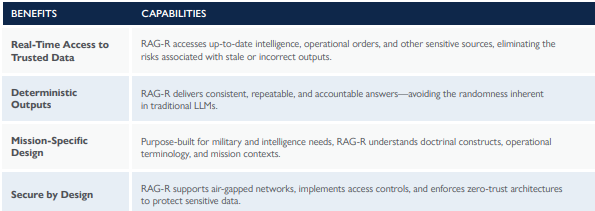
Retrieval-Augmented Generation with Reasoning (RAG-R): A New Approach for Mission Success
RAG-R offers a breakthrough methodology that integrates generative AI with real-time, mission-specific data
Why It Matters