






Letter from the CEO
Jim Carroll
CEO, Professional Services Council
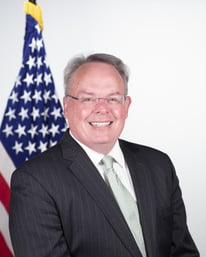 On behalf of PSC and our member companies, it is my honor to introduce the Leveraging Innovation for America’s Veterans Compendium.
America’s veterans have earned the highest standard of care, service, and support. This compendium highlights how PSC member companies are partnering with the Department of Veterans Affairs and other federal agencies to deliver innovative solutions that improve outcomes for the men and women who have served our nation.
From modernizing health care and electronic health records to strengthening cybersecurity, enterprise technology, data management, and supply chain operations, PSC member companies are helping government provide more effective, secure, and responsive services. The examples featured in these pages demonstrate how innovation can improve access to care and benefits, enhance the veteran experience, and deliver meaningful results for veterans and their families.
Behind every modernization effort is a veteran relying on the services and benefits they have earned through sacrifice. PSC and its member companies are proud to support the federal government’s mission and remain committed to advancing solutions that honor veterans by improving the care, services, and outcomes they receive every day.

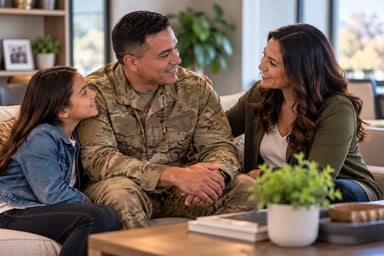 The transition from military to civilian life brings challenges, from navigating benefits and health care to supporting a family through significant change. Across Leidos, teams work with government customers to make those experiences easier for service members, veterans and their families. That includes experience supporting VA disability examinations through Leidos QTC Health Services, connecting military families with resources through Military OneSource and expanding access to health services in underserved communities. Beyond its government work, Leidos supports programs benefiting veterans, caregivers and military families. Together, these efforts reflect a shared commitment to reducing barriers, improving access and creating a more connected experience for those who served.
Military service may end on a particular date, but the transition to civilian life does not.
For many veterans and their families, leaving the military means navigating unfamiliar systems for benefits, health care, employment and family support, sometimes while managing an injury or health condition.
At Leidos, we see opportunities to make that journey easier.
Across the federal government, Leidos supports missions that touch the lives of service members, veterans and military families. Veterans within our own workforce help shape that work, bringing firsthand understanding of military service and the transition that follows.
Leidos QTC Health Services is perhaps best known for supporting the Department of Veterans Affairs disability examination process. We are proud of that responsibility, but it is only one part of our broader commitment to those who served.

 With one in six of our employees Veterans themselves, supporting Veterans and their families is more than what we do – it’s who we are. Loyal Source combines a skilled workforce, operational expertise, and technology to support government missions and those they serve. We have operations in all 50 states, more than 125 clinics, mobile medical units, and a network of more than 4,000 cross-specialty providers supporting Veteran access. In total, Loyal Source has served more than one million Veterans in partnership with the U.S. Department of Veterans Affairs.
Our work combines national reach with a simple responsibility: understand the mission, respect the individual, and follow through. Our experience supporting healthcare for Veterans, Warfighters, and their families has reinforced the importance of clear communication, accessible support, and dependable execution. These principles connect our history of service with our future direction. As needs evolve, our focus remains on practical ways to make services more responsive and reliable—guided by the needs of Veterans, Warfighters, and their families.
What Serving Veterans Has Taught Us
At Loyal Source, serving Veterans has reinforced something simple: how we do the work matters as much as getting it done. What looks like a routine interaction with an organization can be an important moment to the person seeking support. A conversation before an examination, help preparing for an appointment, or a clear answer about what comes next can make a meaningful difference. Letting Veterans’ needs and experiences guide our work means recognizing the importance of those moments—and approaching each one with care.
Across our company’s history of supporting government missions, we have learned to look beyond the task in front of us and consider the person relying on it. We have served more than one million Veterans—a scale that makes personal attention more important, not less. Behind that number is an individual who deserves clear information, respect, and dependable follow-through.
That perspective also asks us to look beyond whether a service is available and consider what stands between a Veteran and that service. Distance, uncertainty about a process, or difficulty connecting with the right support can make the next step harder. We are committed to understanding those barriers and working with our government partners to address them. The starting point is not a tool or a workflow. It is the Veteran—and what would make getting support easier.
For a Veteran in a rural community, that may mean bringing services closer through a mobile clinic rather than expecting the individual to make a long journey. Paired with clear communication and help preparing for the visit, a mobile clinic can address distance while preserving personal attention. The principle is simple: adapt the way services are delivered to the people who need them—not the other way around.
Three lessons stand out. They are not complicated, but they deserve our attention every day.
1. Make the next step clear.
We may know how a process works. The Veteran seeking support may not. Where do I start? What do I need to do? What happens next? We should not assume those answers are obvious. Clear information and timely updates are part of the service—not extras.
Sometimes that means taking a few extra minutes to explain what to expect at an examination or appointment. Sometimes it means checking that instructions are understood and giving someone room to ask a question. For us, completing a step is only part of the job. Helping a Veteran feel prepared to take that step matters too.
2. Keep a person available when help is needed.
Technology can make it easier to find information and connect with support. It cannot replace every conversation. When someone has a question or something does not go as expected, being able to reach a knowledgeable person matters.
Our Veteran-focused footprint includes more than 125 clinics nationwide and more than 4,000 providers supporting Veteran access. But reach alone does not tell us whether someone can get the help they need. We want our tools to help our teams serve people—not put more distance between them. Respect means making room for a conversation and following through on the question.
There is no single experience of being a Veteran, and no single way to make support accessible. We need to listen before assuming what someone needs. Our willingness to address barriers should show up in practical ways: making information easier to understand, helping identify the right next step, and working through obstacles rather than treating them as someone else’s problem.
3. Listen—and act on what Veterans tell us.
Positive responses help us understand what is working. Concerns show us where to look more closely. Neither should be reduced to a number on a dashboard.
If Veterans repeatedly tell us a message is unclear or a question takes too long to resolve, we need to understand why and make a change. That requires humility: being willing to hear where an experience fell short, even when a process worked as designed. Listening is not the end of the process. It is the beginning of better follow-through—and an opportunity to make the next Veteran’s experience better.
Design Around the Veteran
Investment in technology, including AI solutions, is critical. This strengthens access, care coordination, and better care experiences for Veterans, Warfighters, and their families. But technology's value depends on designing experiences and solutions from the perspectives of the Veteran that we're serving. Human-centered design helps make that happen. It begins with research, not assumptions: listening to Veterans, observing how they navigate support, and learning from the teams delivering it. What appears to be a technology problem may also involve unclear communication, a difficult handoff, or a process that asks too much of the person seeking help.
From there, the discipline turns findings into practical changes, tests solutions with the people who will use them, prepares teams to deliver them, and measures whether they work. Feedback and performance data should guide continued improvement—not simply confirm that something launched. It is a repeatable way to turn what Veterans tell us into better service.
As we look ahead, these lessons will guide how we grow. We will keep asking where barriers remain, working alongside our partners, and pursuing practical ways to make services simpler and more dependable—letting the needs of Veterans, Warfighters, and their families shape what we build, how we deliver, and how we measure progress.
Supporting Veterans, Warfighters, and their families is a responsibility we carry into every interaction. Whether we are helping someone prepare, answering a question, or removing an access barrier, the purpose remains the same: honor their service through our own—with respect, personal attention, and a commitment to follow through.

Every Veteran encounter generates clinical documentation that must be accurately coded to support care, quality reporting and appropriate reimbursement. Solventum helps the Department of Veterans Affairs (VA) do that work faster and more consistently by bringing computer-assisted coding (CAC), autonomous coding and clinical documentation integrity (CDI) together on a FedRAMP®-authorized platform the VA already relies on. The result is trustworthy, expert-guided AI that reduces administrative burden and gives VA professionals more time for the complex work that matters most.
AI within the VA: Practical, trustworthy and mission-focused
The VA has set a clear vision for artificial intelligence: improve outcomes and experiences for Veterans by developing trustworthy AI capabilities that support the agency's mission. That vision is backed by a public AI strategy, an inventory of AI use cases and a compliance plan aligned with federal AI requirements. For health information management teams, the opportunity is especially advantageous. Coding and documentation are high-volume, rules-driven and labor-intensive, and they directly affect data quality, revenue recovery and the accuracy of the record that follows a Veteran throughout care.
Solventum's role is making AI practical in this environment. Rather than generic AI, our technology is purpose-built around deep healthcare coding, grouping, clinical and regulatory expertise. CAC augments the coder, autonomous coding automates appropriate coding workflows and CDI helps strengthen documentation at the point where better clinical information can make the greatest difference. Together, these capabilities create a scalable foundation designed to improve efficiency, consistency and documentation quality while reducing avoidable administrative work.
Solventum has more than four decades of experience working with the Federal government including extensive support with the VA. In December 2025, the VA renewed Solventum encoder software licenses and support services for enterprise medical coding, billing, auditing and integration across VA medical facilities. Solventum's federal team includes Veterans and industry insiders who understand the mission and speak its language.
Building on the Solventum™ 360 Encompass™ System foundation
From the moment clinical documentation is captured, Solventum supports an accurate record as AI-powered CDI strengthens documentation at the source and CAC and autonomous coding turn it into a final, compliant code set. That workflow complements the VA's Federal Electronic Health Record Modernization (FEHRM) program rather than competing with it.
Modernization does not have to mean starting over. The Solventum 360 Encompass System coding platform aligns with the FEHRM program, helping reduce implementation risk and support continuity with the VA’s technology strategy. Solventum 360 Encompass works with the documentation the EHR produces, giving coding teams a consistent, secure workflow throughout the transition within a FedRAMP Moderate Environment and VA-authorized Federal cloud boundary.
Autonomous coding, which is the next iteration of medical coding, can also be implemented on the same platform that the VA already uses, eliminating the need to procure, integrate and secure a new system. The Solventum™ 360 Encompass™ Autonomous Coding System reviews all available encounter data and determines which encounters qualify for automation and which need a human coder. Qualified encounters are coded, completed without coder touch and readied for billing. Encounters that do not meet automation criteria flow into the familiar CAC workflow, with the reasons they did not passnoted so coders can resolve them quickly.
Key capabilities include:
• Confidence scoring that allows only confident, compliant charts to move forward without coder touch
• Expert-guided, multi-level AI models informed by deep clinical and coding expertise, coding guidelines and regulatory updates
• Customer-defined exception criteria that let the VA control what is automated
• End-to-end governance with quality assurance workflows, dashboards and full visibility into what was automated, what was not and why
• Support for internal and external audits, designed to withstand payer scrutin
"Modernization does not have to mean starting over. Autonomous coding is the next step on the Solventum platform, not a new system to procure, integrate and secure."
The ROI story: Capacity, speed and confidence
Coding demand continues to outpace the supply of qualified coders. Autonomous coding helps close that gap by removing repetitive, lower-complexity encounters from manual queues so experienced coders can focus on complex cases, audits and education.
The return on investment (ROI) shows up in several ways:
• Capacity: Qualified encounters are completed without coder touch, helping teams absorb growing volumes without proportional
staffing increases or outsourcing
• Speed: Solventum's autonomous pipeline helps reduce coding backlogs and shortens the time from discharge to final coded
• Accuracy and compliance: Expert-guided AI, confidence scoring and validation workflows support complete, compliant code sets
and audit readiness
• Workforce value: Coders spend less time on routine work and more time applying their expertise where it matters most
The results are proven at scale. Solventum's AI models have processed more than 17 million encounters and qualified more than 6.5 million charts autonomously. One leading Midwest health system achieved up to 80% automation and 95% coding accuracy with Solventum Autonomous Coding while reducing the “coder equivalent” by over 30 FTEs and the cost by more than $2 million in a single year. Another academic medical center in the southern region implemented autonomous coding in professional services and was able to reduce the “coder equivalent” by 39.5 FTEs and $2.6 million in one year.
Security first: A FedRAMP-authorized platform sponsored by the VA
For federal health agencies, security is not optional. Under the sponsorship of the VA Electronic Health Record Modernization Integration Office (EHRM-IO), the Solventum RevCycle Health Services Platform (RHSP) received FedRAMP authorization in May 2022 as a Software-as-a-Service (SaaS) offering capable of Government Community Cloud deployment.
Hosted in AWS, the platform supports the Solventum 360 Encompass front end that resides inside the federal enclave and aligns with all applicable VA requirements for cybersecurity, privacy and responsible use of AI. It operates as a single shared-technology platform serving both the VA and the Department of War, which means investments in security, compliance and AI capabilities can benefit the broader federal health community. Because Solventum Autonomous Coding builds on this authorized environment, the VA can expand its use of AI without introducing a new, unvetted cloud footprint.
Your data stays yours: Responsible AI by design
Trustworthy AI depends on how data is handled. Solventum applies strict AI governance built on trust, privacy and security, and customer data is encrypted in transit and at rest.
Data rights, intellectual property and engine provenance: The VA maintains full ownership and control of its data, while Solventum retains ownership of the Solventum 360 Encompass and Autonomous Coding technology. VA data is handled only within the authorized scope and applicable security, privacy, hosting, governance and records-retention requirements; it is not used to train shared, public or external AI models without prior written VA approval, and is never used to train public or commercial AI models. Combined with FedRAMP controls, this gives VA leaders the confidence to adopt new AI capabilities while protecting Veteran information and maintaining control of their data.
White-glove partnership with a dedicated client advocate
Technology alone does not deliver outcomes. Solventum customers are supported by a dedicated client advocate who serves as a trusted advisor and strategic partner. For the VA, that means a single point of accountability who knows the agency's environment, builds relationships with leaders, proactively removes barriers and connects teams with Solventum's clinical, coding and technical experts. Backing up that advocate is more than 40 years of clinical and coding expertise and more than 400 clinical and medical coding content experts who guide product development and support customers.From implementation and phased rollout to optimization and ongoing performance review, the client advocate helps ensure the VA realizes measurable value from Solventum Autonomous Coding and stays ahead of regulatory and coding changes.
"Technology alone does not deliver outcomes."
Advancing the mission for Veterans
The VA has the foundation in place: a trusted coding platform, a FedRAMP authorized environment that the VA sponsored and a clear vision for trustworthy AI. Autonomous coding builds on that foundation to reduce administrative burden, improve consistency and give VA professionals more time for complex work that supports high-quality care. With continued investment and partnership between government and industry, AI can help the VA serve Veterans more efficiently today while building a stronger, more resilient health system for the future.
About Solventum
At Solventum, we enable better, smarter, safer healthcare to improve lives. As a new company with a long legacy of creating breakthrough solutions for our customers' toughest challenges, we pioneer game-changing innovations at the intersection of health, material and data science that change patients' lives for the better while enabling healthcare professionals to perform at their best. Solventum's health information solutions are used in more than 75% of U.S. hospitals and process millions of clinical documents every month. More than 85% of VA medical centers license at least one Solventum solution. Learn more at solventum.com